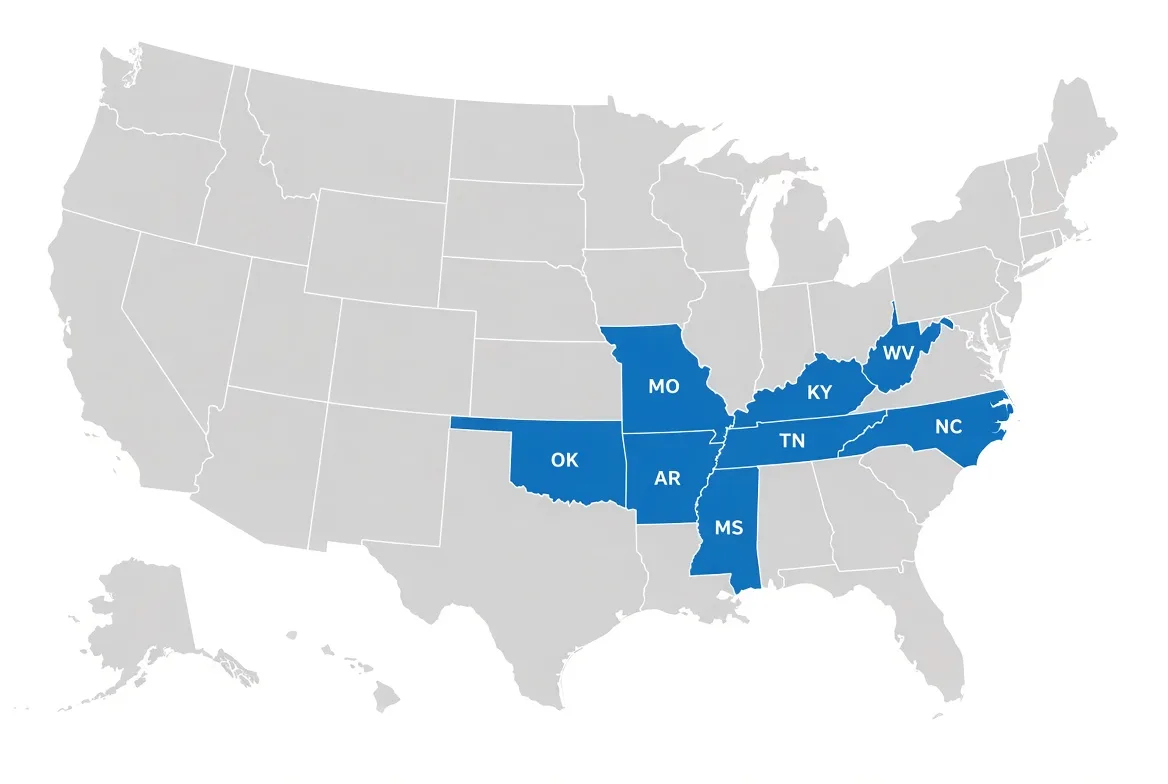
Land is not bought. This page cuts the eight-state list down to a search. It is a planning decision, not a purchase.
The $25,000 startup budget does not include land or housing. Irrigation was already ruled out, because a well and a pivot would spend that budget before a crop exists. A parcel also needs legal access, a perc test that can pass, water you can price, and a few flat acres. The filter that built the list is on the location post.
Ten acres at the 2026 average
Every price below is USDA farm real estate for 2026. It includes buildings. A raw listing can be lower. A house, or ground near a city, will be higher. The source is the USDA NASS Land Values 2026 Summary.
| State | Per acre | 10 acres | Still in the search? |
|---|---|---|---|
| Oklahoma | $2,620 | $26,200 | No. The discount is drought. |
| West Virginia | $3,640 | $36,400 | No. The discount is missing flat ground. |
| Mississippi | $3,650 | $36,500 | Hills only. Not the Delta. |
| Arkansas | $4,350 | $43,500 | Yes. |
| Missouri | $5,200 | $52,000 | Yes. |
| Kentucky | $5,600 | $56,000 | Yes. |
| North Carolina | $5,750 | $57,500 | Coastal plain only. |
| Tennessee | $6,500 | $65,000 | Plateau only. |
Ten acres in Oklahoma average $26,200. Ten acres in Tennessee average $65,000. That gap is about $39,000 before closing. The gap is real. It is also the wrong way to pick a state, because the cheap acre and the usable acre are often not the same acre.
Why the cheap end fails
Oklahoma is the price outlier, and it is the dry outlier. The state averages about 37 inches of rain. The Panhandle is well below that. The southeast is well above it. The $2,620 average is low because a lot of the state is dry pasture. A western listing that only works with a pivot fails the budget. Irrigation was ruled out on the location page. So Oklahoma comes off the active search. The detail is on the Oklahoma post.
West Virginia fails a different test. The average is $3,640, close to Mississippi. The discount is slope. Usable flat ground is scarce, and the acre you can build on is a small piece of the deed. A low price per acre does not help if the garden site is a hillside. That is the same failure as a perc test that will not pass. West Virginia comes off the active search. The detail is on the West Virginia post.
Why the expensive end is parked, not cut
Tennessee has the highest average in the set, at $6,500 an acre. Ten acres at that figure is $65,000 before a well. The average is pulled up by ground near Nashville. Plateau listings, in counties such as White, Overton, and Fentress, sit well below it. So Tennessee is not rejected. It is parked. Only a Plateau listing stays in the search. The state average does not. The detail is on the Tennessee post.
North Carolina is parked for the same reason. The 2026 average is $5,750. The 2022 census put mountain farmland near $7,850 and the coastal plain near $4,440. Mountain ground is the short-season, high-price end. A coastal-plain listing can stay in, and only if drainage is priced. The state is not the search. The region is. The detail is on the North Carolina post.
What stays in, and why
Four states stay in the active search. Missouri, Kentucky, Arkansas, and the hills of Mississippi still show below-average parcels with enough rain and a chance of a few flat acres.
Missouri averages $5,200. The Ozarks are steeper and cheaper than that. Bottom ground costs more. Rainfall is about 42 inches, which is enough to stay off irrigation. The risk is karst and a failed perc, not drought. The detail is on the Missouri post.
Kentucky averages $5,600. Eastern woodland in the 2025 extension survey was about $1,600 an acre. Bluegrass cropland was about $8,300. The east is the search. The Bluegrass is not. The risk is slope and access, which is why a listing there still has to show a flat acre on the deed. The detail is on the Kentucky post.
Arkansas averages $4,350. Delta ground is priced as cropland. Ozark and Ouachita ground is timber and slope, closer to the pasture figure. The hills are the search. The Delta is a different farm, and a different price. The detail is on the Arkansas post.
Mississippi averages $3,650 and about 59 inches of rain. That is the wet end of the set. The hills can stay in. The Delta cannot, unless the build site is out of the flood pool and the price reflects that risk. Cheap bottomland that floods is not a discount. The detail is on the Mississippi post.
What a listing still has to pass
The state cut does not clear a parcel. Four checks still apply in the four states that remain. First, legal access has to be on the deed, not a handshake or a creek bed. Second, a perc test has to pass on the ground you would build on. Ozark karst and Delta clay fail for different reasons. Third, water has to be reachable without a new irrigation system. Fourth, there has to be enough flat acre for a garden and a building without a cut road.
If one check fails, the low price is the cost of that failure. The enterprise is still open. What can fit the startup budget is on the farming-type post. The next work is listings in Missouri, Kentucky, Arkansas, and the Mississippi hills. Nothing here is a purchase.
Sources
- USDA NASS, Land Values 2026 Summary. Farm real estate per acre for all eight states.
- The state posts linked above. Each one has the regional split, the rainfall figure, and the tax line.
2 thoughts on “Which states still fit a small farm land budget”